Posts

Showing posts with the label discipleship

Short-Term Missions, the Savior Complex and Dealing with our own Stuff (Part 2)

Image
I think it’s about time that I write the follow up post to my Short-Term Missions blog back in March. In the first blog, I talked primarily about the Savior Complex. The Savior Complex is the idea that we as Americans/Westerners are the ones who are to “save” those in poverty, as if we have all the answers. As much as we might have good ideas and the know how to help those in poverty, the Savior Complex creates an “Us” and “Them” mentality, which, in my mind, is heretical according to the overall teaching in Scripture. Simply put, this teaching in Scripture is we’re all created in the image of God and everyone (regardless of income, education and culture) is need of a Savior, which should cause us to embody a radical sense of equality in cross-cultural Christian work. Christians are called to humbleness because, at the very core of our faith is the reality, Christ did for us what we couldn’t do for ourselves. Humanity was in an unrecoverable mess without the intervention of...

Slowness and Its Benefits

Image
You've probably come across this verse before: "The Lord is not slow to fulfill his promise as some count slowness, but is patient toward you, not wishing that any should perish, but wishing that all should reach repentance." (2 Peter 3:9, ESV) In this verse, the writer of 2 Peter is inviting the audience to re-imagine what seems to be God's inaction. The writer in this verse is using the word "but" to make a pretty strong distinction. In the ancient Greek language (what the NT was written in) there are two different forms of the word "but",  δέ and   ἀλλά . The first common word for "but" in ancient Greek is the word  δέ (de).  δέ is not often translated into our English translations because it's typically  insignificant in the meaning of the sentence. The other form of the word "but" is  ἀλλά (alla).  ἀλλά is almost always translated into our English versions of the Bible because it's used when the writer i...

How Do I Connect with God? Understanding Different Expressions of Christian Spirituality

Image
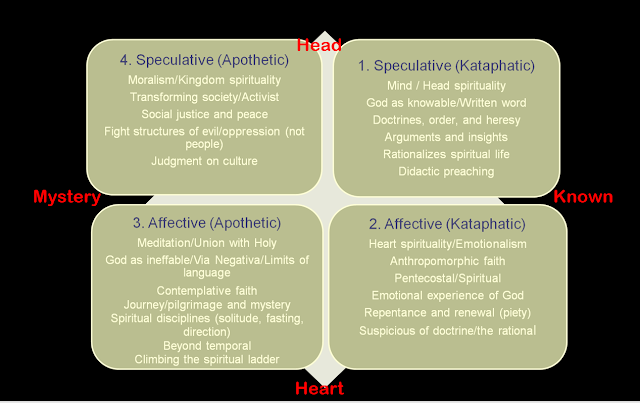
This statement won't surprise you: we're all different. This is one of the greatest challenges of Christian community. Somehow, we're expected to love God, love each other and work together as God's people, the Church. That's easier said than done! On one hand, we are called to learn to love and see ourselves, our unique traits, as valuable (Gen 1), but on the other hand we are "[...] Buried with Christ through baptism into death in order that, just as Christ was raised from the dead through the glory of the Father, we too may live a new life" (Rom 6:4). The word the Apostle Paul uses in Romans 6:4 translated here as "new" comes from the Greek word kainos which may be better translated as "a new quality(or state) of life". Paul isn't saying that baptism "freshens" us up, as the translation seems to say. Paul is literally saying that the Christian life is a transformative experience and we're not, in his mind, the same ...

Giving Back: An Interview with Jimmy Moore, Founder of Fountain of Life Rescue Mission, and Some Thoughts on Faith and Good and Works

Image
      Since the Protestant Reformation, Christians have struggled to find a balance between faith and works. The Roman Church leading up to the Reformation in the 16th Century placed huge amounts of emphasis on works and taught that works contributed toward personal salvation. Protestants, as the name implies, protested such ideas and sought to place the focus, not on human deeds, but on Christ's sacrificial, complete and saving work. However, a type of counter argument arose among this new Christian movement and it goes something like this: why should I do anything if Christ has done all things for me? Why should I continue to do good things if it doesn't affect my salvation at all? To come against this type of thinking, protestant theologians worked to defend the importance of one's good works, but with a protestant twist. My personal favorite example of this comes from an old German catechism dated around 1563 called  The Heidelberg Catechism .   ...

From Hate to Love

43  “ You have heard that it was said, ‘ You shall love your neighbor   and hate your enemy.’   44  But I say to you,  love your enemies and pray for those who persecute you,   45  so that you may be  sons of your Father who is in heaven; for He causes His sun to rise on  the  evil and  the  good, and sends rain on  the  righteous and  the  unrighteous.   46  For  if you love those who love you, what reward do you have? Do not even the tax collectors do the same?   47  If you greet only your brothers, what more are you doing  than others ? Do not even the Gentiles do the same? 48  Therefore you are to be perfect, as your heavenly Father is perfect. (Matthew 5:43-48, NASB) The text above comes from a very popular part of Matthew's gospel, most commonly known as The Sermon on the Mount. It follows closely after what we learned about this past Sunday at Thomasville...

What is Good for Our Hearts

16  And someone came to Him and said, “Teacher, what good thing shall I do that I may obtain  eternal life?”   17  And He said to him,  “Why are you asking Me about what is good? There is  only  One who is good; but  if you wish to enter into life, keep the commandments.”   18  Then  he *said to Him, “Which ones?” And Jesus said,  “ You shall not commit murder; You shall not commit adultery; You shall not steal; You shall not bear false witness ;   19  Honor your father and mother ; and  You shall love your neighbor as yourself .”   20  The young man *said to Him, “All these things I have kept; what am I still lacking?”   21  Jesus said to him,  “If you wish to be complete, go  and   sell your possessions and give to  the  poor, and you will have  treasure in heaven; and come, follow Me.” (Matt 19:16-21, NASB) Within the text above is one of the questions s...